
Why Founders Fail at Sales Follow-Up (and How to Fix It)
Discover why founders fail at sales follow-up and how to fix it in 2026. Master founder-led sales with AI-driven systems and stop losing deals to silence.
Why Founders Fail at Sales Follow-Up (and How to Fix It)
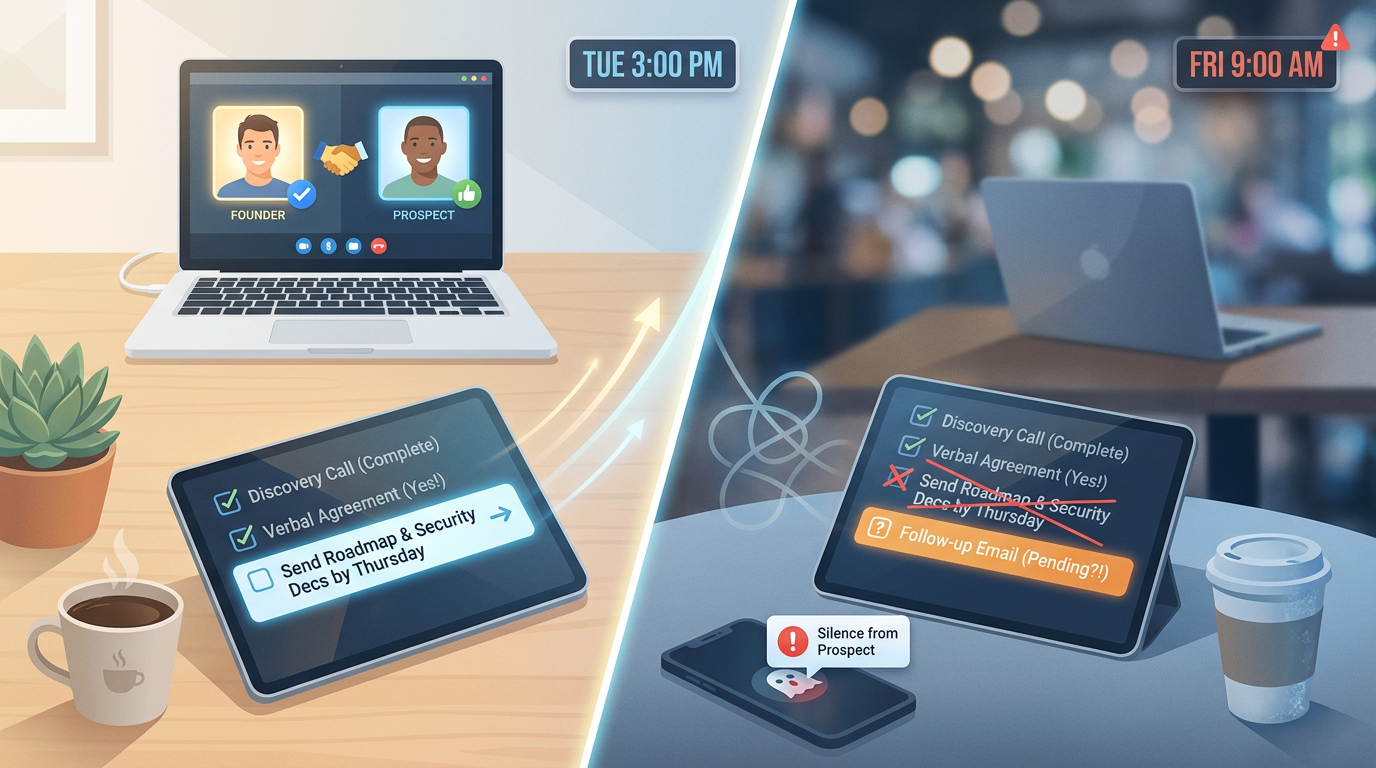
It is a scenario playing out in thousands of Zoom rooms and coffee shops every day in 2026. You, the founder, have just finished a brilliant discovery call. The prospect was engaged, the product-market fit felt electric, and you ended the call with a verbal agreement to "send over the implementation roadmap and the revised security docs by Thursday."
You feel a surge of momentum, certain this deal is headed for a signature.
But then, reality hits. Your next meeting starts in three minutes. After that, there’s a product bug that needs your attention. By the time Thursday rolls around, the "security docs" task is buried under fifty unread emails. Two weeks later, you finally remember to send the follow-up, only to receive a polite, devastating reply: *"Thanks for checking in, but we actually decided to move forward with a competitor who was a bit more proactive."*
If this sounds familiar, you aren't alone. In fact, you are the norm. Understanding why do founders fail at sales follow-up is the first step toward reclaiming your revenue and building a sales engine that doesn't rely on your perfect memory.
The Gap Between a Great Call and a Closed Deal
The sales statistics in 2026 remain as unforgiving as ever. Data shows that 70% of lost sales are attributed to a simple lack of follow-up. It isn't that the product was bad or the price was too high; it’s that the conversation simply stopped.
There is a psychological phenomenon known as the "Post-Call High." This is the peak of optimism immediately following a successful pitch. You feel like the deal is "in the bag." However, this high is almost always followed by the "Two-Week Silence"—the graveyard where deals go to die.
The core problem is rarely a lack of desire or care. Most founders are incredibly passionate about their customers. The problem is the lack of a follow-through engine that fits a founder’s specific workflow. To bridge this gap, founders need to implement simple follow-up systems for founder-led sales that automate the administrative burden.
Closing a deal is rarely about the first contact; only 2% of sales close at that stage. The remaining 98% are won through the discipline of the follow-through.
Psychological and Systemic Barriers to Founder Follow-Up
Why is follow-up so much harder for founders than for dedicated sales reps? The answer lies in the unique cognitive load of a founder.
1. The Context-Switching Tax
Founders are the ultimate multi-hyphenates. In a single afternoon, you might switch from "Product Visionary" to "Customer Support" to "Legal Reviewer." Sales follow-up requires a specific type of administrative focus. Pivoting from a complex technical sprint to "Sales Administrator" mode is cognitively draining, leading to procrastination.
2. The "CRM Friction" Trap
Most founders have a "love-hate" (mostly hate) relationship with traditional CRMs. You’ve likely tried the industry leaders and quit them within a month. Why? Because they are built for Sales VPs who want dashboards, lead scoring, and forecasting. They aren't built for the person actually doing the selling. When a system requires more time to maintain than it gives back in value, founders instinctively optimize it out of their day.
3. The Exhaustion of Manual Review
By 2026, AI note-takers like Granola, Fireflies, and Google Meet's native tools are omnipresent. But having a transcript isn't the same as having a plan. The mental load of re-reading or skimming a 45-minute transcript just to find one specific promise about a SOC 2 document is often enough to make a founder "do it later"—which usually means "never."
Why Your Current System (Spreadsheets and Calendars) Is Failing You
If you’ve moved away from bloated CRMs, you’ve likely settled on a "manual" stack: a mix of Google Sheets, Apple Reminders, and starred emails. This is a recipe for disaster in 2026 for three reasons:
The "I'll Do It Later" Fallacy: Manual note-taking relies on your discipline in the heat of the moment. If you don't record the task immediately, it effectively doesn't exist.
The Fragmentation of Truth: Your commitments are scattered. Some are in a meeting note, some are in a Slack DM, and some are in a notebook. When information is fragmented, follow-up becomes a scavenger hunt.
The Persistence Wall: 80% of deals require five or more follow-ups to close. Manual systems work for the first follow-up, but they almost always fail by the fourth or fifth attempt. Persistence is a game of systems, not willpower.
Building a High-Performance Sales Discipline Without the Bloat
To solve the follow-up failure, you don't need a bigger CRM; you need a thinner process. You need a system that does the "follow-up thinking" for you.
Move from 'Note-Taking' to 'Action-Extracting'
In 2026, you shouldn't be writing down what you need to do next. Your tools should tell *you*. By using AI action extraction, you can turn a transcript from a call into a dated action plan in seconds. The goal is to identify every commitment—both yours and the prospect's—automatically.
The Power of Account-Based History
Instead of a "pipeline" that emphasizes stages and probability percentages, founders need a "Customer Page." This is a single, living document per account that collapses every call, note, and email into one view. When you can see the entire history in one scroll, you never lose the context of the deal.
Reducing Friction in Outreach
The hardest part of following up is "Blank Page Syndrome." You know you need to email a lead, but you spend 10 minutes agonizing over the wording. A high-performance system drafts that follow-up for you based on the actual context of your last conversation. You just review, edit, and hit send.
How Nudge Fixes Founder Follow-Up Failure Automatically
This is where nudge comes in. Nudge is the follow-through engine specifically designed for founders who sell. It isn't a traditional CRM—it’s the muscle and the memory that ensures every deal gets the persistence it deserves.
Import from Anywhere: Whether you use Granola, Fireflies, Google Drive, or Gmail, nudge pulls your notes and transcripts into one central hub.
AI Action Extraction: Nudge reads your transcripts and pulls out every next step with suggested dates. "I'll follow up Thursday" becomes a task on your list instantly.
The Unified Task List: No more hopping between boards. Nudge gives you one view of everything you need to do across every customer, sorted by urgency.
Drafts Ready to Send: Nudge generates follow-up emails based on what you actually discussed. It removes the friction of outreach, allowing you to work your list in minutes.
Stop Losing Deals to Silence
Sales isn't just about charisma or a great product—it's about the consistent work that happens between the meetings. If you are a founder who has "quit three CRMs" or feels the stinging regret of a deal that went cold because you forgot to email back, it's time for a change.
Switch from a system you have to maintain to one that does the follow-up thinking for you.
Join the founders who've stopped losing deals to silence and start using nudge today.
FAQs
Q: Is nudge a replacement for my CRM?
A: For many founders and small teams, yes. Nudge provides the action-oriented parts of a CRM (task management, customer history, follow-up tracking) without the bloat of dashboards. If you need a tool that helps you close deals rather than just report on them, nudge is for you.
Q: Do I have to change where I take notes?
A: No. Nudge is designed to work with your existing workflow. You can paste transcripts or pull them directly from Granola, Google Drive, Gmail, or Fireflies.
Q: How does the AI extraction work?
A: Nudge uses advanced LLMs to analyze your call transcripts and notes. It identifies specific commitments (e.g., "I'll send the case study") and suggests dates based on the conversation context.
Q: Is there a free version for founders just starting out?
A: Yes! Our Free plan includes 5 customer pages and 10 imports per month, which is perfect for founders in the early stages of sales. No credit card is required to start.
Q: How long does setup take?
A: Nudge takes about five minutes to set up. Your first customer page can be ready before your next call ends.