Simple Sales Tracking for Founders (No Bloat)
Stop losing deals to dashboard bloat. Learn how simple sales tracking and a follow-through engine can help founders close more sales in 2026.
Simple Sales Tracking Without the Dashboard Bloat
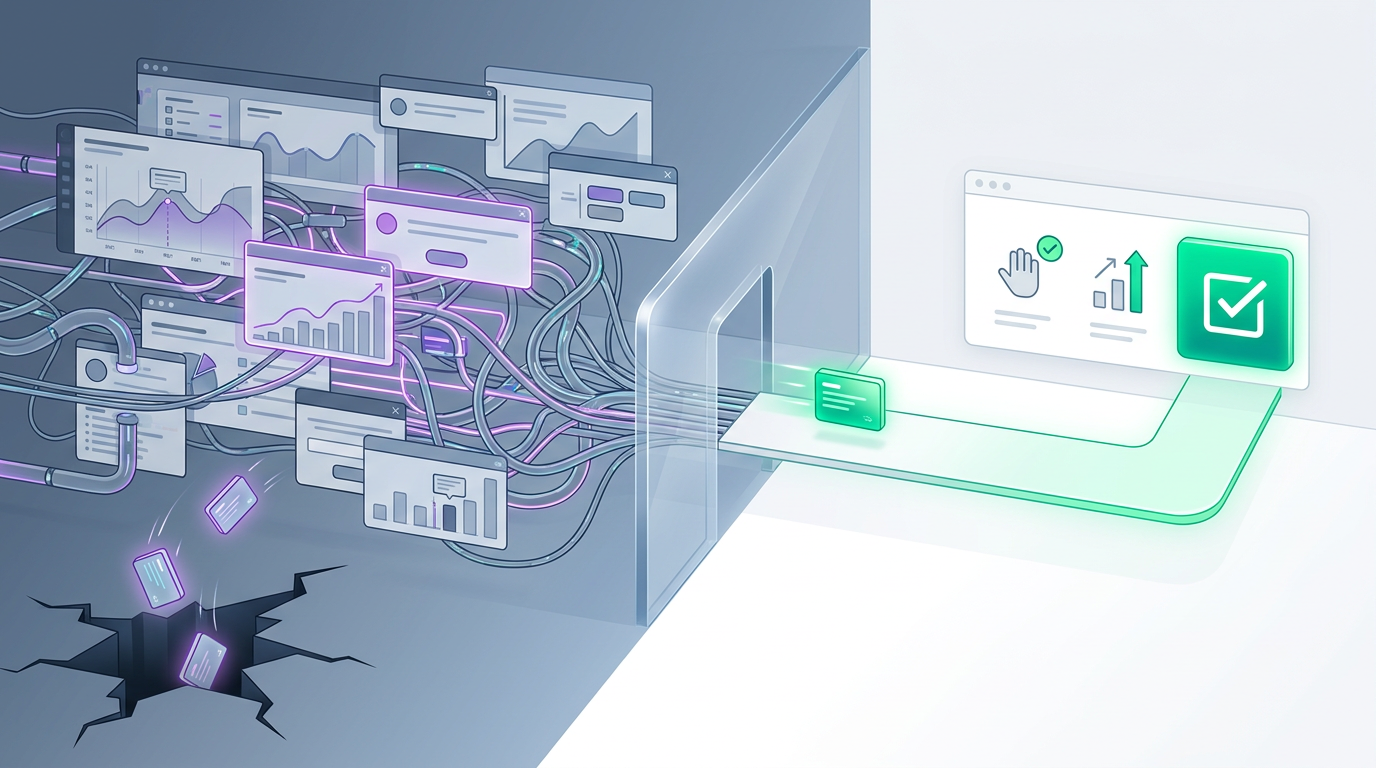
In the fast-paced business landscape of 2026, founders are more productive than ever, yet a classic problem remains: deals are still slipping through the cracks. It’s rarely because the product isn’t good or the market isn’t ready. It’s because the tools we were told would help us—massive, enterprise-grade CRMs—have become the very obstacles preventing us from closing.
If you’ve ever looked at a complex sales dashboard and realized you have no idea what the actual "next step" is for your most important prospect, you aren't alone.
It’s time to embrace simple sales tracking without dashboards and bloat.
The High Cost of Over-Engineered Sales Tools in 2026
We are currently living in an era of "tool fatigue." The average founder’s tech stack is a fragmented mess of AI agents, communication platforms, and project management boards. Traditional CRMs were built for sales managers who want to see reports, not for the founders actually doing the selling.
The ‘Dashboard Delusion’
Many founders fall into the trap of the "Dashboard Delusion." You spend hours configuring pipeline stages, lead scores, and colorful probability charts. It feels like work. It looks like progress. But charts don’t buy your product—people do.
A dashboard might tell you that you have $500,000 in your "Negotiation" stage, but it won’t remind you that you promised a prospect you’d send revised SOC 2 docs by Thursday afternoon. When you spend more time updating custom fields than you do talking to customers, the tool has stopped serving you.
The Truth About Why Deals Fail
The data in 2026 is as brutal as it was a decade ago:
70% of lost sales are lost due to a simple lack of follow-up.
80% of deals require at least five follow-ups to close.
Over 45% of representatives never follow up after the first call.
Deals don’t die because your dashboard wasn’t pretty enough; they die in the silence after a great meeting. They die because you meant to follow up, but the task stayed in your head instead of getting onto a list.
Why ‘Simple Sales Tracking’ is the Secret Weapon for Founders
For a founder-led sales team, the goal isn't "pipeline management"—it's momentum management. When you are building the product, hiring the team, and closing deals simultaneously, you don't need a system that requires a PhD to navigate. You need a system that ensures you never break a promise to a prospect.
Managing a Pipeline vs. Following Through
A pipeline is a macro view—great for board meetings but terrible for daily execution. Following through is a micro-discipline. It’s about the specific commitments made during a 20-minute Zoom call.
Most founders try to bridge this gap with manual spreadsheets or calendar reminders. While these work for a few active deals, they inevitably break down as you scale. A spreadsheet is static; it doesn't know that the "check-in next week" you promised in an email is now overdue.
The Essential Elements of a Lean System
To achieve simple sales tracking without dashboards and bloat, your system only needs three things:
Customer History: A single chronological view of every interaction.
Extracted Actions: A list of what was promised by both you and the prospect.
Automated Follow-up: A way to execute that next step without starting from a blank page.
This is where nudge changes the game. It isn’t a CRM; it’s a follow-through engine. It replaces the "busywork" of data entry with the "discipline" of action.
How to Build a High-Discipline System Without the Bloat
Building a system that actually sticks requires removing friction. If a task takes more than thirty seconds to log, a busy founder simply won't do it. Here is how to architect a high-discipline sales workflow in 2026.
Automation over Administration
You should never have to manually type "Follow up with Pier on pricing" into a database. In 2026, the technology exists to do this for you. By using tools like nudge, you can import transcripts directly from where you already work, such as Granola, Fireflies, Google Drive, or Gmail.
The AI reads the transcript, recognizes the intent, and builds the action plan for you. The administration happens in the background while you focus on the conversation.
Centralizing Customer Context
One of the biggest time-wasters for founders is the "context hunt." You have a call scheduled in five minutes, and you’re frantically searching through Gmail threads and Slack messages to remember what you discussed last time.
The solution is a unified customer page. Nudge auto-builds an organized page for every account. No setup, no custom fields—just every conversation, note, and action collapsed into a single living document. The history is always one scroll away.
Turning Call Notes into Actionable Follow-Ups
The transition from "meeting" to "action" is where most sales are lost. Here is how to use nudge to ensure that never happens again.
The Power of ‘Action Extraction’
During a sales call, you might make several micro-commitments: "I'll send that case study," or "I'll get you a draft MSA."
Nudge’s AI action extraction identifies these specific commitments and assigns suggested dates. You don't have to reflect on the call and take notes later; the engine has already pulled the "heavy lifting" out of the transcript.
Reducing Friction in Outreach
The hardest part of following up isn't the "doing"—it's the "drafting." Staring at a blank email trying to remember the exact tone of a conversation is a recipe for procrastination.
Nudge solves this by drafting the follow-up email for you based on the actual call context. You review it, tweak a sentence, and hit send. What used to take twenty minutes now takes twenty seconds.
The Unified Task List
Instead of looking at a pipeline of 20 deals in various stages, you look at one Unified Task List, sorted by urgency and organized by account:
Today: Send Acme updated security docs.
Wednesday: Share case study with Lattice.
Friday: Helio legal review of MSA.
Conclusion: Discipline Over Dashboards
In 2026, the competitive advantage isn't having the most sophisticated CRM. The advantage goes to the founder who is the most reliable. The founder who does what they said they would do, exactly when they said they would do it, wins the trust that closes the deal.
The best sales system is not the one with the most features; it’s the one you actually use. Stop managing a pipeline and start managing your follow-through. Switch from a bloated CRM to nudge—the follow-through engine built for founders who sell.
Start following through with nudge for free.
FAQs
Q: How is nudge different from a traditional CRM?
A: Traditional CRMs focus on reporting and data entry for management. Nudge focuses purely on action. It replaces complex dashboards with automated task extraction to ensure nothing is forgotten.
Q: I already use an AI note-taker like Fireflies. Do I need nudge?
A: Yes. While AI note-takers capture what was said, nudge helps you *act* on it. It turns those transcripts into a persistent, organized action plan.
Q: Does nudge work with my existing tools?
A: Absolutely. You can import transcripts or notes directly from Google Drive, Gmail, Granola, and Fireflies.
Q: Is there a free version for founders?
A: Yes! Nudge offers a free tier that includes 5 customer pages and 10 imports per month, complete with AI action extraction. No credit card is required to start.