
Sales Tracking: Best Spreadsheet Alternatives for 2026
Stop losing deals to messy spreadsheets. Discover the best sales tracking alternatives in 2026 to automate follow-ups and close more deals effortlessly.
Sales Tracking: Best Spreadsheet Alternatives for 2026
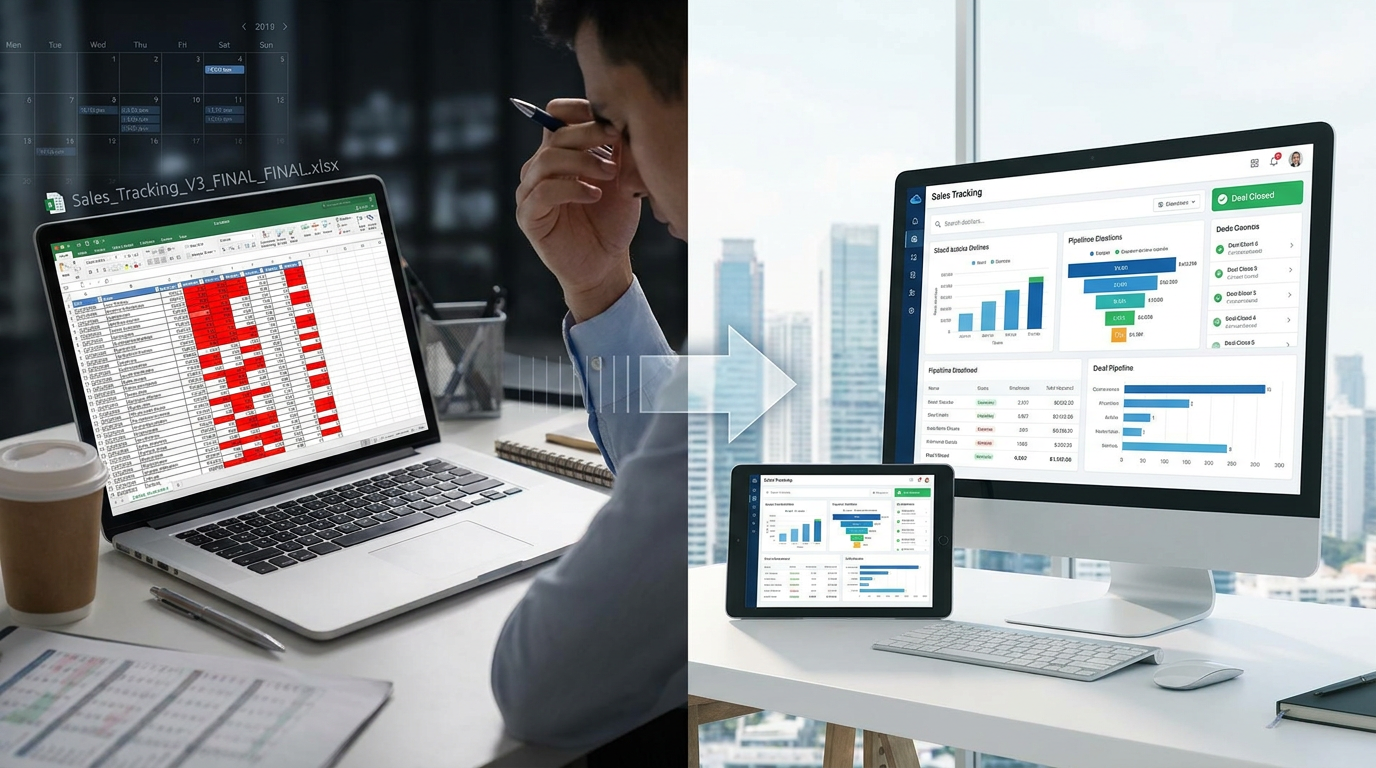
You’ve been there before. It’s 6:00 PM on a Tuesday, and you’re staring at a spreadsheet named `Sales_Tracking_V3_FINAL_FINAL.xlsx`. There are four tabs, forty rows of potential leads, and a dozen cells highlighted in red because you can’t remember if you actually sent that case study to the CEO of Acme Corp—or if you just *thought* about sending it while grabbing coffee.
For years, the spreadsheet has been the default starting point for every founder-led sales motion. It’s free, familiar, and flexible. But as we move through 2026, the cracks in the "spreadsheet method" have become wide enough for multimillion-dollar deals to fall through.
The goal isn't just to store data; it's to ensure that no commitment made in a meeting is ever forgotten.
The Spreadsheet Trap: Why 'Good Enough' is Killing Your Deals
Founders default to spreadsheets for a logical reason: speed. When you are in the "zero to one" phase, firing up a Google Sheet or an Airtable base takes thirty seconds. It feels light. It feels like progress.
However, spreadsheets are the ultimate "Silent Deal Killer." They suffer from one fundamental flaw: they are passive.
The Data Entry Gap
The moment your meeting ends, the "Manual Data Entry Gap" begins. To keep a spreadsheet useful, you must manually transcribe your thoughts (or your notes) into a cell:
"Follow up Thursday with the revised SOC 2 docs."
"Pricing is too high for their current budget; check back in Q3 2026."
"Introduce them to the product lead next week."
If you don't type these into the sheet immediately, they don't exist in your system. As any founder knows, the thirty minutes after a sales call are usually filled with another call, a Slack fire, or a product bug. By the time you get back to your spreadsheet, the nuance is gone.
Storage vs. Action
Spreadsheets are designed for data storage, not for driving behavior. A row in a sheet doesn't tap you on the shoulder. It doesn't tell you *what* to say.
The High Cost of Manual Sales Tracking in 2026
The complexity of the modern sales stack has made manual tracking even more draining. In 2026, our meetings are recorded by AI, our notes are stored in Notion, and our conversations happen across Gmail, LinkedIn, and Slack.
The 70% Problem
Statistically, 70% of lost sales are attributed to a lack of follow-up. It isn't that the product was bad or the price was too high; it’s that the trail went cold. Data shows that 80% of deals require five or more follow-ups to close, yet 48% of sales reps never follow up after the first contact.
When your system is a spreadsheet, the friction of following up becomes an insurmountable wall.
The 'Context Switch' Tax
Every time you want to follow up with a lead using a spreadsheet, you have to:
Open the spreadsheet.
Find the specific row.
Open Gmail to see the last thread.
Open your meeting recorder (like Granola or Fireflies) to remember what was promised.
Draft an email from scratch.
This constant context switching is a hidden tax on your productivity. It turns a five-minute task into a twenty-minute hurdle. In the fast-moving startup environment of 2026, that's time you simply don't have.
Beyond the Sheet: What to Look for in a Lightweight Alternative
When searching for an alternative to spreadsheets for tracking sales follow-ups, many founders make the mistake of jumping straight into a traditional CRM like Salesforce or HubSpot.
The problem? Most "heavy" CRMs are just spreadsheets with more buttons and higher monthly fees. They are built for VPs of Sales who want dashboards, not for founders who need to close deals.
Look for 'Follow-Through Engines'
Instead of a database, you need a follow-through engine. This is a tool that prioritizes actions and commitments over pipelines and lead scoring.
Essential features for a 2026 sales workflow:
Automatic Data Extraction: The tool should "read" your meeting transcripts and pull out "Next Steps" automatically.
Unified Task Lists: Instead of clicking through forty different customer folders, you should see one view of everything you need to do today, sorted by urgency.
AI-Assisted Outreach: If you promised a case study, the tool should draft the email for you based on the context of the conversation.
Introducing Nudge: The Non-CRM for People Who Actually Sell
Nudge was built specifically for the founder who has "quit three CRMs" and is tired of the spreadsheet grind. It isn't a complex ecosystem of fields; it is a dedicated engine designed to ensure you never miss a follow-up again.
The 'Import to Action' Workflow
Nudge replaces the manual data entry of a spreadsheet with a streamlined four-step process:
Import: Paste a transcript or sync directly from tools you already use like Granola, Fireflies, Google Drive, or Gmail.
Organize: Nudge automatically builds and updates a dedicated page for each customer.
Action: Nudge's AI reads your transcripts and extracts every commitment—yours and theirs—with suggested dates.
Follow Through: Your tasks appear in a unified list. When it’s time to act, Nudge drafts the outreach based on the transcript.
Feature Spotlight: AI Action Extraction
Imagine you just finished a call with a prospect at Acme Corp. In the meeting, you said, "I'll get you the revised security docs by Thursday."
In Nudge, the system identifies that sentence in the transcript and automatically creates a task: *"Follow up Thursday with revised SOC 2 docs"* assigned to Acme Corp. You didn't have to type a single word.
How to Transition from a Sales Spreadsheet to an Automated System
Moving from a messy spreadsheet to an automated follow-through engine like Nudge shouldn't take a full weekend. In 2026, software should work for you, not the other way around.
Step 1: Consolidate Your Context
Stop hunting through Drive folders. Import your existing notes and transcripts into Nudge. The system will collapse every meeting, email, and commitment into a single living page per account, creating a "Source of Truth" that is actually readable.
Step 2: Establish the 'Review & Send' Habit
The biggest bottleneck in sales is the "blank page" problem—staring at a new email window wondering how to phrase the follow-up. Using Nudge, you switch to a "Review & Send" model where the AI provides the draft and you simply provide the final approval.
Step 3: Work the Unified Task List
Forget looking at a "Pipeline View." Pipelines are for managers; task lists are for closers. By working from a unified task list, you ensure that the persistence required to close a deal happens automatically.
Conclusion: Closing the Follow-Up Gap
Most deals don't die because the prospect said "no." They die in the silence that follows a great first meeting.
If you are still using a spreadsheet to track your sales in 2026, you are fighting an uphill battle against human nature. You are relying on your own discipline to bridge the gap between "having a meeting" and "taking an action."
Modern founders use systems like Nudge to turn notes into an organized action plan. Stop being a data entry clerk for your own sales process and start using a system built for follow-through.
Start your first Nudge customer page today—no credit card required.
FAQs
1. Why is a spreadsheet a poor tool for tracking sales follow-ups?
Spreadsheets are static and require 100% manual maintenance. If you forget to update a cell, the system breaks. Modern alternatives like Nudge automate data entry by extracting tasks directly from your meeting transcripts.
2. Is Nudge just another CRM?
No. Traditional CRMs focus on reporting and forecasting. Nudge is a "follow-through engine" that focuses exclusively on the actions required to move a deal from a first call to a signed contract.
3. Does Nudge work with my current note-taking tools?
Yes. Nudge is designed to sit on top of your existing workflow. You can import transcripts or notes directly from Granola, Fireflies, Google Drive, and Gmail.
4. How long does it take to set up Nudge?
Setup takes about five minutes. Because it builds customer pages automatically based on your imports, your first account page is usually ready before your next meeting even ends.
5. Why is follow-up so important for founders?
Statistically, 70% of sales are lost due to a lack of follow-up. Founders are often stretched thin, making them prone to letting leads slip. A system that "does the thinking for you" ensures you maintain the persistence needed to close.