Sales Follow-Up Discipline for Busy Founders in 2026
Master sales follow-up discipline in 2026. Learn how high-growth founders use AI and lean systems to eliminate post-call silence and close 80% more deals.
Sales Follow-Up Discipline for Busy Founders in 2026
It is June 2026, and the landscape of founder-led sales has shifted. While AI-driven outreach tools have flooded the market with automated sequences, the most successful founders are winning deals exactly the same way they always have: through high-touch, personalized follow-up.
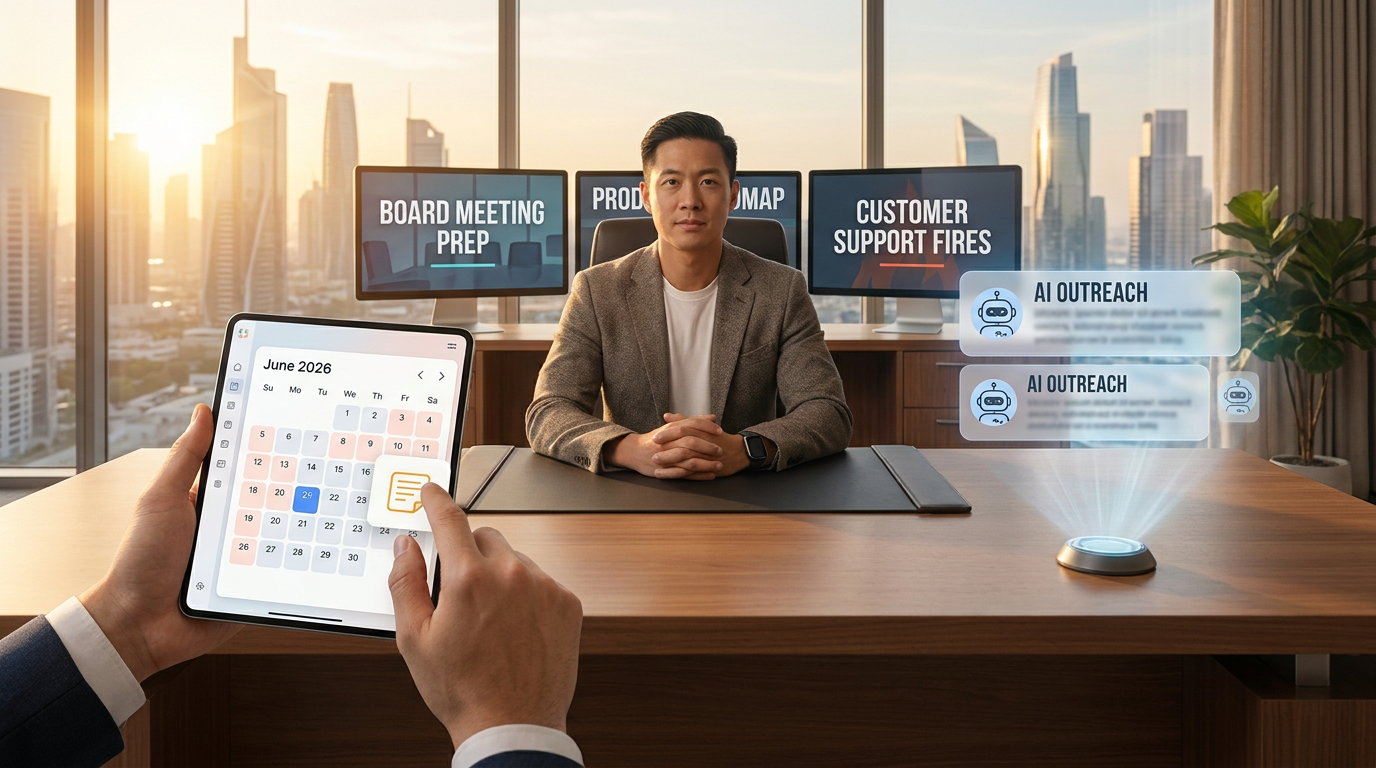
However, a massive problem remains. You have a brilliant discovery call. The prospect is nodding; the value proposition is clear; the energy is high. You hang up the call, feeling like the deal is already in the bag. Then, the "Founder’s Reality" sets in. You have a board meeting to prepare for, a product roadmap to review, and three fires to put out in customer support.
By the time you look at your notes again, ten days have passed. The momentum is gone, and a cold silence has set in.
The High Cost of Post-Call Silence for Founders
In 2026, the "Founder’s Sales Trap" is more dangerous than ever. This trap occurs when a founder’s multifaceted responsibilities prevent them from executing the most critical phase of the sales cycle: the post-call follow-through.
The data is sobering. Research consistently shows that 70% of lost sales are lost solely due to a lack of follow-up. It’s rarely about the price or the product features; it’s about the silence. While 80% of deals require at least five follow-ups to close, nearly half of all sales representatives—and an even higher percentage of busy founders—never follow up after the initial contact.
Why does this happen? Most founders treat follow-up as a personality trait—something they "should" be better at—rather than a professional system. They rely on "remembering" to send that revised SOC 2 document or that specific case study.
In a world of constant distractions, human memory is a poor tool for revenue generation. Creating an effective sales follow up discipline for busy founders requires moving away from sheer willpower and toward a "follow-through engine" that does the heavy lifting for you.
To streamline this process, many are looking beyond traditional software.
Why Traditional CRMs Fail Busy Founders
By now, most founders have a "graveyard" of CRMs they’ve tried and abandoned. Salesforce, HubSpot, and Pipedrive are powerful, but they were built for sales managers who need reporting, not founders who need to sell.
The Problem of 'Bloat' and Busywork
Traditional CRMs are designed around "fields" and "pipelines." They demand that you categorize leads, assign scores, and update stages. For a founder-led team, this is often just expensive busywork. You don’t need a dashboard showing your "projected Q4 churn" when you are simply trying to remember to email Sarah at Acme Corp by Thursday afternoon.
Managing Systems vs. Closing Deals
Manual data entry is the death of productivity. When a tool requires more time to maintain than it saves in execution, it gets ignored. This is why founders often quit multiple CRMs before realizing the problem isn't their discipline—it's the tool. In 2026, a founder's focus must remain on taking action on commitments made during calls, not moving digital cards across a Kanban board.
3 Steps to Rebuild Your Sales Follow-Up Discipline
To stop losing deals to silence, you must transform your workflow from a series of "reminders" into a streamlined execution line. Here is the three-step framework for 2026:
Step 1: Automatic Action Extraction
Stop re-reading transcripts. Whether you use Granola, Fireflies, or Google Gemini to record your calls, the last thing a busy founder has time for is hunting through a 45-minute transcript to find three action items.
The first step in modern follow-up discipline is using AI to instantly identify every commitment. Your system should be able to identify the sentence, *"I'll send over the pricing tiers by Wednesday,"* and automatically turn it into a dated task without you typing a single word.
Step 2: Unified Accountability
Hunting through Gmail threads, Slack messages, and physical notebooks is a recipe for missed revenue. Effective discipline requires a Unified Task List.
This list should be account-centric, not just date-centric. You need to see every outstanding action across all your deals in one view, sorted by urgency. When you can see that you have "6 actions across 5 customers" at a glance, the mental load of "What am I forgetting?" disappears.
Step 3: Reducing the Friction of Outreach
The biggest delay in following up is often "writer's block." You know you need to email the prospect, but you spend 20 minutes trying to remember the specific context of their concern regarding API integration.
By pulling data directly from your call notes, your system should draft the follow-up email for you. In 2026, the goal is to spend your time reviewing and sending, not drafting from scratch. When the friction of writing is removed, the speed of follow-up increases exponentially.
Leveraging nudge: The Follow-Through Engine for Small Teams
This is where nudge fits in. nudge isn't another CRM; it’s a follow-through engine designed specifically for founders who realized that pipelines don't close deals—persistence does.
Customer Pages, Auto-Built
With nudge, every customer gets their own "living page." You don't have to set anything up manually. When you import a transcript or a note, nudge automatically organizes it into a single, chronological view. Every conversation, every commitment, and every shared document is one scroll away, providing the discipline of a CRM without the unnecessary bloat.
AI-Driven Action Extraction
nudge reads your transcripts and pulls out the next steps with suggested dates. If you promised to follow up Thursday with revised documents, nudge creates that task for you. It eliminates the "thinking" part of the follow-up, leaving you only with the "doing."
Integrated with Your Existing Workflow
You don't have to change your routine to use nudge. It works with the tools you already use—Granola, Google Drive, Gmail, or Fireflies. You simply paste a transcript or pull it directly from your existing apps, and nudge turns those stale notes into an actionable plan in seconds.
For founders who sell, nudge offers:
Unified Task List: One view of EVERYTHING you need to do, organized by account.
Email Drafts: Ready-to-send emails based on actual call context.
Zero Setup Time: Be ready for your next call in five minutes.
Conclusion: Persistence is the Product of a Better System
In the high-stakes environment of 2026, you cannot afford to let 70% of your potential revenue slip through the cracks because of a "full inbox."
Persistence isn't just an innate talent; it’s the result of having a system that makes persistence the path of least resistance. Since 80% of deals require five or more touches, failing at the second touch means handing market share to competitors who simply stayed in the conversation longer.
Stop trying to force discipline and start using a system designed for the way founders actually work. nudge ensures that no deal dies in the silence after a great call.
FAQs
1. How is nudge different from a CRM like Salesforce or HubSpot?
nudge is a "follow-through engine" rather than a traditional CRM. It ditches complex pipelines and manager reporting in favor of founder-centric "action"—extracting tasks from your calls and helping you send follow-up emails in seconds.
2. Do I have to manually enter all my meeting notes?
No. nudge is designed to minimize manual entry. You can import transcripts directly from tools like Granola, Fireflies, and Google Drive. nudge uses AI to read those notes and automatically build a customer page and task list for you.
3. Can I use nudge if I already have a transcript tool I like?
Yes. nudge works with what you already use. It sits on top of your note-taking or recording stack (Gmail, Drive, etc.) to turn those notes into an organized action plan.
4. How long does it take to set up?
nudge takes about five minutes to configure. Because it doesn't require mapping fields or building pipelines, your first customer page is usually ready before your next call even ends.
5. Why is the 'follow-through' so important for founders specifically?
Founders are uniquely prone to "Post-Call Silence" because they have more competing priorities than a dedicated salesperson. nudge automates the "administrative thinking" of sales, ensuring the founder stays focused on closing without letting deals fall through the cracks.