AI Sales Task List Generator from Meeting Transcripts (2026)
Stop losing deals to poor follow-up. Learn how an AI sales task list generator turns 2026 meeting transcripts into actionable follow-through engines.
AI Sales Task List Generator from Meeting Transcripts: The Founder’s Edge in 2026
The year 2026 has brought a definitive realization for the modern entrepreneur: selling isn't about the pitch—it’s about the follow-through. We’ve moved past the era where a charismatic demo could carry a deal to the finish line. Today, buyers are more distracted, procurement cycles are more complex, and the noise in the average inbox is deafening.
Yet, despite the advancement of large language models and sophisticated communication tools, a startling statistic remains: 70% of lost sales are attributed to a lack of follow-up. It’s rarely that the product isn't a fit; it's that the momentum died in the silence between the first call and the second.
For founders and small sales teams, the bottleneck isn't a lack of effort. It’s "Post-Meeting Paralysis." You finish a great call, you have three more back-to-back, and by the end of the day, those critical action items are buried somewhere in a 45-minute transcript. This is where an AI sales task list generator from meeting transcripts becomes less of a luxury and more of a survival tool.
The High Cost of Sales Administrative Friction in 2026
In the current market, speed is the primary competitive advantage. When a prospect says, "Send me that SOC 2 doc on Thursday," and you send it on Thursday, you build trust. When you send it the following Tuesday because you forgot which meeting that request came from, you erode it.
The "Post-Meeting Paralysis"
Most founders leverage tools like Granola, Fireflies, or Google Meet to record their sessions. While having a transcript is a great safety net, it creates a new form of "administrative debt." You end up with a library of text but no clear direction. Spending 20 minutes re-reading a transcript to find five minutes' worth of action items is a recipe for burnout.
The CRM Trap
Traditional CRMs were designed for managers to track reps, not for founders to close deals. They require manual data entry, field tagging, and pipeline moving—all of which feel like "busywork" when you have a product to build. Throughout 2026, we've seen thousands of founders "quit" their CRMs because the friction of maintaining the system was higher than the value the system provided. When you prioritize manual data entry over actual selling, you lose the very deals you’re trying to track.
How an AI Sales Task List Generator Bridges the Productivity Gap
An AI sales task list generator like nudge doesn't just store information; it filters for intent. It moves beyond the generic "summary" (which often misses the nuances of a deal) and focuses on the high-stakes "who, what, and when."
Moving Beyond Generic Summaries
In 2026, we don't need another AI to tell us "the meeting went well." We need an engine that identifies:
Your promises: "I will send over the pricing tier by Wednesday."
The prospect's commitments: "I will check with the legal team about the MSA."
Implied dates: When a prospect says "early next week," the AI should intelligently date that task for Monday or Tuesday.
Account-Level Organization
The power of nudge lies in its ability to collapse the chaos. Instead of having notes in a notebook, transcripts in a recorder app, and follow-ups in a calendar, nudge builds a living page for every customer. This page automatically updates with every new transcript or email, providing a single, scrollable history of the relationship.
Action Engines vs. Data Storage
The fundamental shift in 2026 is moving from "Data Storage" (Old CRM) to "Action Engines" (nudge). An action engine doesn’t care about complex "lead scoring" algorithms; it cares about the fact that you haven't emailed Sarah at Acme Corp in four days even though you promised her a case study.
From Transcript to Action: A 3-Step Workflow for Founders
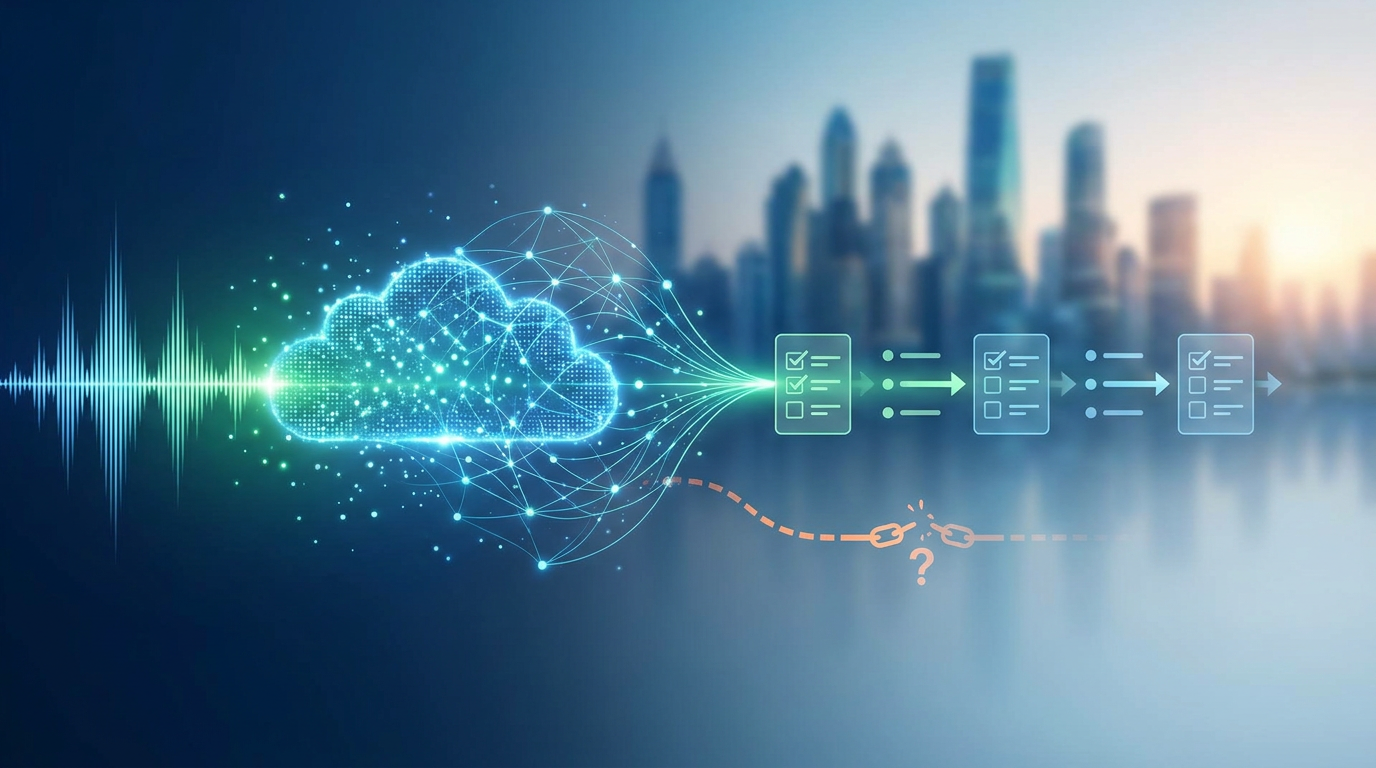
Using an AI sales task list generator should feel like having a chief of staff sitting in on your calls. Here is how the workflow works in nudge:
1. Seamless Importing
You shouldn't have to change how you work. Whether you use Granola for personal notes, Fireflies for meeting recording, or Gemini for AI assistance, nudge allows you to import transcripts and notes directly. It integrates with Google Drive and Gmail to pull the context it needs to organize your world without manual copy-pasting.
2. AI Action Extraction
Once the transcript is imported, the AI reads between the lines. It extracts every next step and attaches the supporting quote for context. If the task is "Follow up Thursday with the revised SOC 2 docs," nudge doesn't just create the task; it links it back to the exact moment in the call where that was discussed so you remember the context behind the request.
3. Unified Visibility
Individual tasks are great, but the Unified Task List is where deals are won. Nudge aggregates every action across every customer into one view, sorted by urgency. You can wake up, look at your nudge dashboard, and see exactly which five customers need a response today to keep the deal moving forward.
Beyond the List: Automating Outreach with AI Drafts
A task list tells you what to do; a follow-through engine helps you accomplish it.
Reducing Activation Energy
The hardest part of following up is the "blank page" problem. Even in 2026, research shows 80% of deals require 5+ follow-ups to close, yet 48% of reps never follow up after the first call because the "activation energy" required to draft those emails is too high.
Nudge solves this by using transcript context to auto-draft the outreach. When it's time to follow up, the draft is already there, referencing specific points from your last conversation.
The "Review and Send" Model
Efficiency should never come at the cost of authenticity. In 2026, customers can smell a fully automated "DRIP" campaign from a mile away. Nudge follows a "Review and Send" philosophy: the AI does the heavy lifting—summarizing the points and drafting the structure—but you maintain the final human touch.
Conclusion: Scaling Sales Without Scaling Admin
Deals don't die because your product isn't good enough. They die in the silence of the post-meeting vacuum. By turning your transcripts into an organized action plan, you ensure that every commitment is honored and no prospect feels forgotten.
Nudge is built for the "person who does it all"—the founder-led sales team that wants the discipline of a CRM without the bloat. In 2026, your competitive advantage isn't just your technology; it's your persistence.
Focus on the follow-through, and the revenue will follow.
[Start building your first customer page in five minutes with nudge. Free. No credit card required.]
Frequently Asked Questions
What is an AI sales task list generator?
It is a specialized tool that uses Natural Language Processing (NLP) to analyze meeting transcripts and automatically identify action items, deadlines, and commitments made by both the seller and the buyer.
How does this differ from a traditional CRM?
A traditional CRM is a database focused on reporting. An AI sales task list generator like nudge is a "follow-through engine" focused on execution. It requires significantly less manual data entry and focuses on individual customer actions rather than high-level forecasting.
Does it work with Zoom, Teams, and Google Meet?
Yes. By importing transcripts from tools like Fireflies, Granola, or your internal recording software, nudge can process data regardless of your conferencing platform.
How specific are the tasks generated?
The tasks are highly specific. Instead of "Follow up with Acme," the AI extracts "Send Acme the updated security questionnaire by Thursday afternoon to confirm the pilot start date."
Is my data secure?
Modern tools like nudge prioritize data privacy, ensuring transcripts are used only to generate your specific task lists, maintaining compliance with 2026 data sovereignty standards and enterprise-grade encryption.